from the Lesson Zone

Students will learn about musical form and terminology by following an icon-based listening map for Bach’s Toccata and Fugue in D Minor.
This lesson is designed to fulfill the 2014 National Standard for Music:
Demonstrate and explain how the expressive qualities (such as dynamics and tempo) are used in performers’ decisions to convey expressive intent. (Responding - MU:Re9.1)
Recording of Bach's Toccata and Fugue in D Minor
Toccata in D Minor | Listening Map & Lesson Plan (Premium)
Small rewards (like stickers or treats)
Step 1
Tell students, "We’re going to learn about one of the most popular organ pieces ever written. It’s so famous that it’s often used in movies and video games! It’s Toccata and Fugue in D Minor by Johann Sebastian Bach."
Step 2
Tell students, "I'm going to give everyone a listening map. When you get it, please place it on the floor in front of you." Pass out the maps. If you'd like to provide a reading opportunity, pass out the "Bach" biography page from the lesson pack as well.
Explain that when Bach composed this piece, it wasn't an instant hit. In fact, it was nearly forgotten for almost 100 years until it was rediscovered by German composer Felix Mendelssohn. Later, Walt Disney included it in Fantasia (1940).
Step 3
Tell students, "Let’s review the listening map. Knowing these symbols will help you read the map."
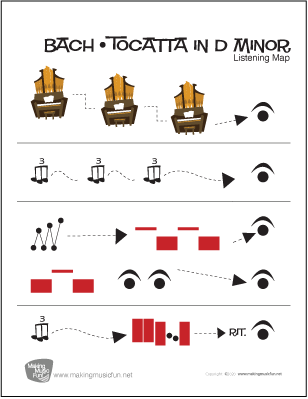
First Section - At the end of the first section, you’ll see a fermata. That symbol tells you to hold the note extra long.
Second Section - In the second section, there are triplets. That means you’ll hear notes grouped in sets of three.
Third Section - The third section has symbols that show you how the notes move higher or lower.
Fourth Section - The last section includes more triplets and a ritardando. Ritardando means to gradually slow down.
Step 4
Tell students, "I'll start the recording. Do your best to follow along. If you get lost, look up at my map to see where we are."
Step 5
Play the recording for the first time.
Step 6
Ask students, "How did you do? Great! This time I'm going to reward the students who stay in the right spot with a piece of candy. I'll start the recording and stop somewhere in the middle. Next, I'll call a name from my roll book. If I call your name, and you're in the right place, you'll win the candy!"
Step 7
Start recording. Randomly stop three times, giving a few more students a chance to win.
Step 8
Wrap the lesson up with a quick review. Ask students, "What instrument was this piece written for?" "Did Bach repeat musical ideas?" "Is this absolute or program music—is it just about the music, or does it tell a story?"
Teacher-approved favorites that make planning a breeze and get kids excited to learn.


Freshly pressed — brand-new resources your students will love!
Instant unlimited access to 650+ premium piano & instrumental sheet music arrangements, theory worksheets and games, composer resources, and lesson plans. New resources added every month. Cancel anytime. Start $36 Unlimited Access

Andy Fling founded MakingMusicFun.net in 2007. With 14 years in the classroom and 19 years creating resources for elementary music education, he is guided by the belief that kids learn best when they're having fun. He is also a big believer in "unplugged" learning and personal connections. Instead of screens and "streaks," his resources focus on teacher-led lessons, real progress, and a lifelong appreciation for music. Read More »